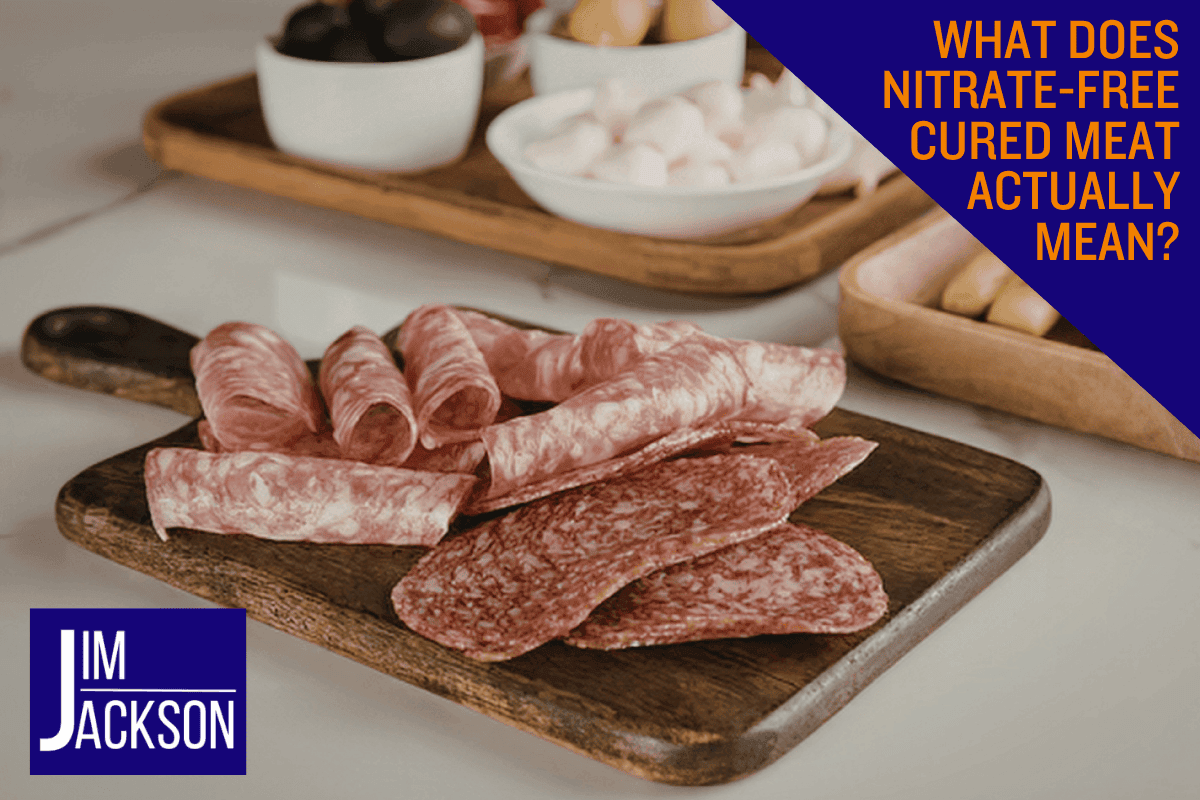
What Does Nitrate-Free Cured Meat Actually Mean?
It’s the newest craze on the block… “nitrate-free”. I’ll be honest, until recently, I didn’t even know nitrate was used in curing meats. I simply gorged on bacon blissfully oblivious.
Well, knowledge equals power; so what’s this nitrate-free fad all about?
You see “nitrate-free” on a pack of cured meat and think, good, that must be the healthier option – It sounds cleaner, safer, and a bit less like something cooked up in a lab.
But is it, really? What even is nitrate? Why is it used in curing meat? Is it dangerous to health? If they don’t use nitrate, what do they use instead? And, is that safe? If so, why are we only using this now?
And the most important question… Do I need to give up bacon forever?!?!?!?
Ok, so many questions. Let’s open this can of worms and see what we find.
TL;DR
✅ “Nitrate-free” does not always mean no nitrate chemistry was involved. Some products still use celery powder, which naturally contains nitrates.
✅ Traditional-style curing can be done without nitrates, using salt, fermentation, drying, and tight hygiene and process control.
✅ Observational studies link processed meat and nitrates with health concerns, but they do not prove a direct cause on their own.
✅ If cured safely with fewer, simpler ingredients, genuine nitrate-free meat may be a more natural and honest option than modern cured meats packed with additives.
Why Are More People Asking About Nitrate-Free Cured Meat?
More people are asking about nitrate-free cured meat because the label sounds cleaner and healthier. It feels like an easy way to dodge something people have been told is bad.
That reaction is understandable. Most people aren’t studying meat curing. They are scanning a packet quickly and trying to make a better-in-the-moment choice.
“Nitrate-free” sounds reassuring. It sounds like the meat has skipped an ingredient that shouldn’t be there in the first place.
But labels often simplify things so much that they become misleading.
That’s why this topic matters. The phrase sounds clear, but the reality is often murky. Some products that look cleaner at first glance are not as different as they seem.
In my own diet, I keep coming back to the same question. Is this real human food? Is it nutritious or damaging to health? What has actually been done to this food?
This is also why nitrate-free cured meat has become such a talking point. It sits right in that sweet spot where modern food marketing meets genuine health concern.
Common-Sense Check
If a label instantly makes a product sound safer, that should make you curious.
Not cynical. Just curious.
Because the front of the pack is designed to sell. The ingredient list is where the truth usually starts.
How Did Humans Traditionally Cure Meat, and How Is Modern Curing Different?
Humans cured meat to make it last longer. Traditional curing was about survival, storage, and reducing waste, while modern curing is more controlled, standardized, and ingredient-driven.
Before fridges, meat spoiled fast. If an animal was killed, people needed ways to keep that food usable for longer.
Salt was a big part of that. So were drying, smoking, and air-curing. These methods helped pull moisture out, slow spoilage, and make meat easier to store or carry.
That puts curing in the same broad camp as fermenting. Both are old preservation methods. Both were ways to make food last beyond the day it was produced.
So curing is not some bizarre modern trick. It’s an old human habit.
What’s changed is the level of control.
Traditional curing leaned on time, salt, airflow, smoke, and local practice. Modern curing often uses precise levels of nitrate or nitrite to deliver consistent color, flavor, shelf life, and microbial safety. That includes protection against dangerous bacteria such as Clostridium botulinum.
That doesn’t mean old equals good and modern equals bad. It means the process today is more exact, more industrial, and more tied to clearly defined curing agents.
That matters because when people talk about cured meat now, they are often talking about a modern version of an old practice.
Quick Comparison
| Traditional curing | Modern curing |
|---|---|
| Salt, smoke, drying, time | Preservation, appearance, flavor, and safety |
| Local methods and variation | Tighter regulation and consistency |
| Preservation first | Preservation, appearance, flavour, and safety |
| Less chemical precision | Exact nitrate/nitrite control |
Common-Sense Check
Humans have preserved meat for centuries. That alone should stop us from treating all cured meat like a brand-new food problem.
But it does not prove every modern cured meat product is harmless either. The details still matter.
What Are Nitrates and Nitrites in Cured Meat?
Nitrates and nitrites are curing agents used to preserve meat, control harmful bacteria, and create the familiar flavor and pink color of cured products. They are not just there for show.
This is where people often get lost.
Nitrate and nitrite are related, but they are not identical. In simple terms, nitrate can convert into nitrite, and nitrite is the more directly active compound in curing.
In cured meat, nitrite helps stop harmful bacteria from growing. It also helps lock in that cured color and flavor people expect from bacon, ham, salami, and similar foods. The USDA’s FSIS explains that cure agents contribute to preservation, cured flavor, and color development.
If you remove nitrates or nitrites, you are not simply removing a random extra. You are changing part of the system that cured meat has relied on for safety, appearance, and shelf life.
But, is this a case of fixing one problem and creating another?
Why Do People Worry About Nitrates and Nitrites?
People worry because nitrates and nitrites are linked to compounds that may raise cancer risk in certain conditions. They also sit within the broader debate about processed meat and long-term health.
This is the part that made nitrate-free such a marketable phrase.
Public health bodies have raised concerns about processed meat for years. Cancer Research UK says eating a lot of processed and red meat can increase bowel cancer risk, and it notes nitrates and nitrites as one possible part of that picture.
The Food Standards Agency says nitrates and nitrites help preserve processed meat, but also states that eating too much processed meat increases cancer risk and that there is no evidence that products made without these additives are safer.
That does not mean one charcuterie board will ruin your life.
It means the concern lies within the broader pattern of regular processed meat intake, not in any single ingredient in isolation. Researchers are also looking at other factors, such as haem iron, salt, smoking by-products, and what can form during high-heat cooking.
This is where nuance matters.
The mainstream concern is real. But that doesn’t automatically mean every front-of-pack warning-by-implication is honest or useful.
Common-Sense Check
A risk signal is not proof that one ingredient is the sole villain.
That is where food conversations often go off the rails. People like simple enemies. Real life is usually messier.
Can Observational Studies Prove Nitrates and Nitrites Cause Health Problems?
No, not for sure. Observational studies can show links, but they cannot prove that nitrates or nitrites directly cause cancer or other health problems on their own.
Much of the concern about processed meat stems from observational research. That means researchers track large groups of people, look at what they eat, and then see which health problems show up more often over time.
That can reveal patterns, and those patterns matter. Major reviews linking processed meat with colorectal cancer rely heavily on this kind of evidence.
But observational studies have a built-in weakness. Real people do not live in a lab. People who eat more processed meat may also be more likely to smoke, drink more alcohol, exercise less, eat fewer whole foods, sleep poorly, or carry more body fat.
Researchers try to adjust for these factors, but they cannot control everything perfectly. That means the results can be skewed by other lifestyle habits that accompany meat intake.
So the honest takeaway is this: observational studies can raise a strong warning flag, but without long-term randomized controlled trials designed to test nitrates and nitrites directly, they cannot prove cause with total certainty.
Common-Sense Check
Although we cannot say for sure that nitrates are directly causing the health issues seen in these studies, common sense tells me that if humans have only been consuming sodium nitrate in recent times, we are probably better off without it.
Does “Nitrate-Free” Really Mean No Nitrates at All?
No, not always. In cured meat, “nitrate-free” can sound far cleaner than the product really is.
This is where the label game starts.
In the U.S., some meats made with plant-based nitrate or nitrite sources have still been labeled “uncured” and “no nitrates or nitrites added,” because the rules focused on added synthetic curing agents rather than every possible source.
That is why products using ingredients like celery powder have been able to wear wording that many shoppers read as “none involved.”
That is a big reason people get confused.
A pack can suggest one thing on the front, while the back reveals that nitrate chemistry is still part of the process. Even extension guidance aimed at consumers says this can be misleading, because nitrates may still be present in a natural form.
So when you see “nitrate-free,” do not assume it means the meat was made with no nitrate pathway at all.
Sometimes it may mean that. Sometimes it only means no synthetic nitrate or nitrite was added directly. That is a very different claim.
Common-Sense Check
If a label needs a footnote to explain itself, it is probably not as clear as it looks.
That does not make it a lie every time. It does mean the front of the pack may be doing some heavy lifting.
Why Do Some “Nitrate-Free” Meats Still Use Celery Powder?
They use celery powder because celery naturally contains nitrates. In curing, that can be used to achieve a similar end result while keeping the label looking more natural.
This is the bit most people miss.
Celery powder is not there because someone wanted to boost the vegetable content of your bacon. It is used because celery can supply nitrate, which can then support the curing process.
Wisconsin Extension says vegetables such as celery are now commonly used as plant-based sources for curing, and UNH Extension notes that products using celery powder can still be labeled “no nitrates/nitrites added” even though nitrates are still being added in a natural form.
That is why the phrase “nitrate-free” can be slippery.
For many shoppers, it sounds like the product has stepped away from nitrate curing altogether. In reality, some brands have simply swapped a purified curing agent for a vegetable-based one.
Chemically, that does not make it a whole new world.
Ultimately, using celery powder may sound better, but the end products still end up with nitrites contained within them – and some would argue more.
Quick Summary
| Label idea | What it often suggests | What may actually be happening |
|---|---|---|
| Nitrate-free | No nitrate-related curing | Plant-based nitrate source may still be used |
| No nitrates or nitrites added | Nothing nitrate-like involved | No synthetic addition, but natural sources may still be present |
| Uncured | Not really cured | Often cured through alternative nitrate sources |
Can Cured Meat Be Made Safely Without Nitrates, Nitrites, or Celery Powder?
Yes, it can. In fact, using salt, fermentation, drying, and careful process control is arguably a more traditional and more natural way to preserve meat.
That is the part often missed in this debate.
Modern food culture can make it sound as if nitrates are the only way cured meat can exist safely. They’re not. Humans preserved meat long before modern curing salts, using methods such as salting, drying, smoking, and fermentation to extend shelf life and reduce waste.
So the idea of nitrate-free cured meat is not strange at all. If anything, it makes more sense to me than relying on concentrated curing agents or plant-based workarounds dressed up as cleaner labels.
The important thing is understanding that removing nitrates does not mean removing preservation. It means preserving the meat through other hurdles instead.
Based on what Nate of Na Kyrsie Meats told me, that means using salt, fermentation, drying, and the control of pH & water activity to create shelf-stable products. For some heat-treated items, he says the process also includes a controlled chilling cycle. That is not “doing less.” It is using a different method.
And to be honest, that would be my preference.
If meat can be preserved without nitrates, nitrites, celery powder, or beet extracts, and done safely, that strikes me as the more appealing route. It feels closer to traditional food preservation and further away from the modern habit of solving everything with added compounds and clever label language.
That said, there is still a catch.
This kind of method has to be done properly.
Why Traditional-Style Preservation Still Needs Care
Fermentation has to lower the acidity enough. Drying has to reduce the moisture enough. Salt, temperature, hygiene, and consistency all matter. A product like this depends on skill and control, not just a nice-sounding claim on the front of the pack.
But that does not weaken the case for genuine nitrate-free cured meat. If anything, it strengthens it.
It means the producer has to rely on craft, process, and proper food handling rather than shortcut ingredients. And in a modern, hygienic facility with tight controls, this kind of traditional-style preservation should be more reliable than it would have been centuries ago.
That is how I see it.
I am not against preservation. I am against pretending a cleaner label is the same as a cleaner product. If a producer can preserve meat in a more traditional way and do it safely, that is the option I would rather have.
Common-Sense Check
If we can back to a more traditional method of curing without the need of potentially unhealthy ingredients and without comprsmising on safety, that must be a better option… right?
Is Nitrate-Free Cured Meat Actually Healthier, or Just Less Bad?
Potentially, yes. If cured meat can be made safely without nitrates, nitrites, or celery powder, using fewer and simpler ingredients, that looks far more like real human food to me.
That is where I land on it.
Not all processing is equal. Salting, fermenting, drying, and smoking are old food traditions. They were used to preserve meat long before modern food manufacturing got involved. That is very different from a product built around modern additives, curing agents, and clever label language.
So if a cured meat can be made safely using salt, fermentation, drying, and proper hygiene, I see that as a better option.
Why?
Because the ingredient list is usually simpler. The process is easier to respect. And the final product is closer to what a human being could have eaten before the modern food industry started redesigning food in laboratories and factories.
That matters.
Many of the additives used in modern cured meats are relatively new in the grand scheme of human history. We would not have been exposed to them for thousands of years in the way we are now.
And when something is both highly manipulated and recently introduced into the diet, I think it is fair to question whether it belongs in a food we eat regularly.
That does not mean every traditional-style cured meat is automatically a health food.
Fresh meat is still the cleaner baseline in my view. But if I am choosing between a cured meat made with a longer list of modern ingredients and one made safely with fewer, simpler, more traditional ones, I know which way I am leaning.
For me, nitrate-free cured meat done properly is not just “less bad.”
It is often more in line with what food should be: recognizable ingredients, a clear purpose, and a process that makes sense without needing a chemistry set to explain it.
Why Simpler Ingredients Matter
The fewer strange additions a food needs, the more confidence I tend to have in it.
That does not mean every ingredient with a long name is automatically harmful. But it does mean I trust foods more when they rely on traditional methods rather than modern compounds to get the job done.
That is really the bigger point here.
I am not saying cured meat should become the centre of the diet. I am saying that if cured meat is going to be eaten, I would much rather it be made in a way that feels closer to old-world food preservation and further away from modern food engineering.
Conclusion
So, we now know that nitrates are used for safety reasons to prevent health risks in the production of cured meats for the masses.
And we know that plant-based nitrates, such as celery powder, are still nitrates despite what the label says.
However, as we’ve solved one problem, we’ve potentially created another by exposing people to the risk of certain cancers.
It reminds me of our modern soaps and personal cleaning products that moved away from animal fats, such as tallow, to plant-based fats.
To overcome the shelf-life issues with such fats, scientists figured out that using substances such as parabens helped. But, parabens turned out to be endocrine-disrupting chemicals linking them to breast cancer… one problem solved, another created.
Perhaps in a time when food hygiene wasn’t as stringent as it is these days, the health risks of nitrates were less of a concern than the risk of nasty bacteria from not using it.
Is that precaution really necessary these days? I don’t think so – there are some, such as Na*Kyrsie Meats, that are proving this
So, like the resurgence of raw milk, I reckon we should bring back proper cured meat – taking it from a cancerous health risk to something more in alignment with real human food…
…minimally processed, nutritious, and damn tasty.
And that’s it… have a nutritious day!
FAQs
Is nitrate-free cured meat always free from nitrates?
No, not always. Some products use celery powder or similar ingredients, which naturally contain nitrates. So while the label may say “no nitrates added,” the meat may still be using nitrate-based curing through a different source.
Are nitrates and nitrites the same thing?
Not quite. They are related, but not identical. Nitrate can convert into nitrite, and nitrite is the more active compound in meat curing. In simple terms, they are part of the same chain, but they do not do exactly the same job.
Why are nitrates used in cured meat in the first place?
They are mainly used to help preserve the meat, control harmful bacteria, and create the pink color and flavor people expect from cured foods. They were not added for no reason, even if people now question their long-term health effects.
Is nitrate-free cured meat healthier?
Potentially, yes, if it is made safely with fewer and simpler ingredients. A genuinely nitrate-free product may be closer to traditional food preservation. But it is still cured meat, so fresh meat is still the cleaner baseline in my view.
How can cured meat be made without nitrates?
It can be done using salt, fermentation, drying, and careful control of pH, moisture, hygiene, and temperature. That approach relies more on traditional preservation methods rather than modern curing agents, but it has to be done properly and consistently.
Should I avoid cured meat completely?
Not necessarily. The bigger point is to understand what you are buying. If you eat cured meat, it makes sense to choose products with simpler ingredients and more honest methods, rather than assuming every “nitrate-free” label automatically means better food.
